
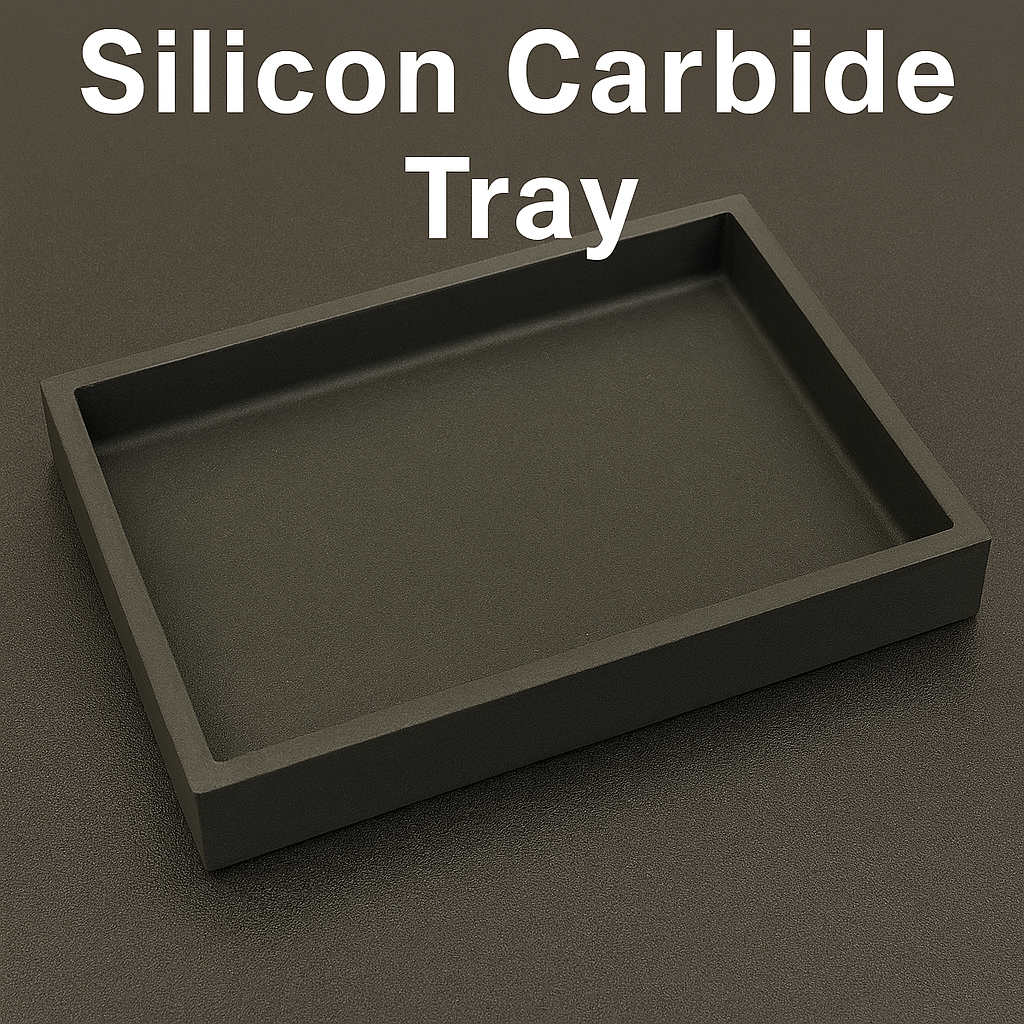
Silicon Carbide Tray
- Custom and standard options available.
- Fast lead times guaranteed.
- High performance at a competitive price.
Silicon Carbide Tray is made from high-purity silicon carbide (SiC) through reaction bonding or sintering, offering excellent heat resistance, uniform thermal distribution to ensure consistent epitaxial layer thickness and resistance, and strong chemical resistance. As a leading supplier and manufacturer of premium silicon carbide products, we can supply high-quality silicon carbide trays with various specifications and competitive prices, offering customized solutions to meet specific requirements.
Silicon Carbide Tray Data Sheet
| Purity: | ≥99% |
| Color: | Black or Dark grey |
| Chemical Formula: | SiC |
| Material Grades: | Reaction Bonded SiC, Pressureless Sintered SiC, Hot-pressed SiC, etc. |
| Density: | >3.2 g/cm³ |
| Maximum Operating Temperature: | 1600℃ |
Silicon Carbide Tray Description
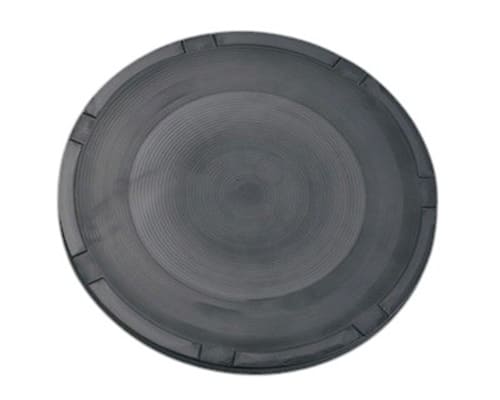
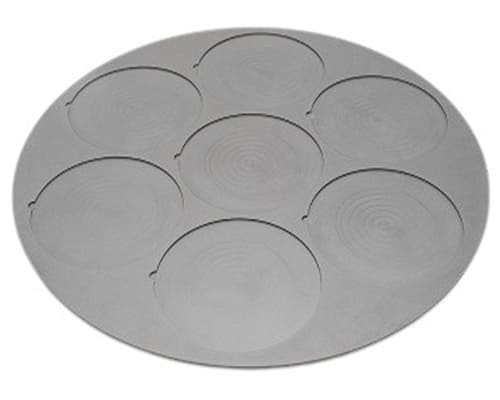
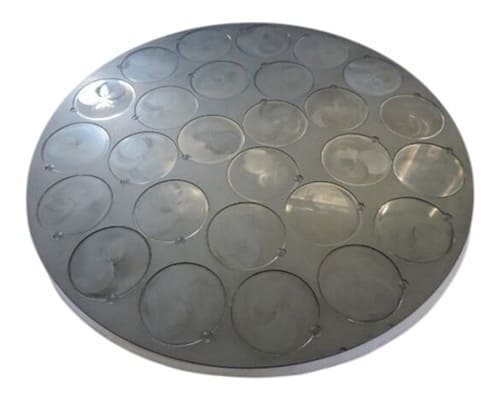
Silicon Carbide (SiC) primarily exists in two crystal structures: the cubic β-SiC and the hexagonal α-SiC. Compared to other ceramics such as alumina (Al2O3) and boron carbide (B4C), SiC exhibits superior mechanical properties, better oxidation resistance, higher wear resistance, and a lower friction coefficient. Silicon Carbide Tray is made from high-purity reaction-bonded silicon carbide (RBSiC), sintered silicon carbide (SSiC), or recrystallized silicon carbide, featuring excellent high-temperature resistance, thermal conductivity, wear resistance, and chemical stability. It is ideal for semiconductor manufacturing, metal casting, heat treatment, solar cell production, and aerospace. NexusX can supply high-precision silicon carbide trays with various specifications and customized solutions for diverse industry and research applications.
Silicon Carbide Tray Features
- High Heat Resistance: SiC has a high melting point and thermal stability, suitable for prolonged use in high-temperature environments (>1500°C) without deformation.
- Excellent Corrosion Resistance: Strong resistance to acids, alkalis, and other chemicals, ideal for corrosive environments.
- High Strength and Hardness: Superior mechanical properties, wear-resistant, impact-resistant, and long-lasting.
- Good Thermal Conductivity: Enables rapid and uniform heat transfer, suitable for processes requiring precise temperature control, such as semiconductor manufacturing.
- Lightweight: Lighter than traditional metal trays, facilitating handling and transportation.
- Low Thermal Expansion: Minimal deformation during temperature changes, ensuring dimensional stability.
- Environmentally Friendly: High durability reduces replacement frequency, lowering resource consumption.
Silicon Carbide Tray Applications
- Semiconductor Manufacturing: For wafer heat treatment, annealing, and epitaxial growth, enduring high temperatures and chemical corrosion.
- Photovoltaic Industry: In silicon wafer production and battery manufacturing for high-temperature sintering and diffusion processes.
- Ceramics and Powder Metallurgy: As sintering trays to support ceramic or metal powder molding.
- Chemical Industry: Used as reactor or container trays in corrosive environments.
- Aerospace: For processing or testing components in high-temperature conditions.


Silicon Carbide Tray Packaging
Silicon carbide foam filter products are typically packaged in vacuum-sealed bags to prevent moisture or contamination and wrapped with foam to cushion vibrations and impacts during transport, ensuring the quality of products in their original condition.

Download
- SAFETY DATA SHEET (SDS) -Silicon Nitride Custom Parts
FAQ
How to select a suitable Silicon Carbide Tray according to application scenarios?
- For industrial kiln transfer: Select the rectangular type with ear plates and reinforcing ribs; opt for designs with hollow holes if heat dissipation is required.
- For high-temperature sintering scenarios: Prioritize hot-pressed sintered silicon carbide materials to ensure long-term stable operation above 1600℃.
What maintenance matters need attention when using Silicon Carbide Trays at high temperatures?
- Clean residual materials on the surface in a timely manner after each use. Use a diamond grinding wheel for gentle polishing and avoid scratching by hard objects.
- Do not stack or subject to heavy pressure during storage. Place separately in a dry environment free of corrosive gases.
What is the typical service life of Silicon Carbide Trays, and what factors affect their lifespan?
- Material quality: Hot-pressed sintered Silicon Carbide Trays have a lifespan 50% longer than reaction-sintered ones.
- Operating temperature: Long-term operation above 1800℃ will accelerate aging and shorten the service life.
- Operation method: Frequent collisions, improper stacking, or failure to clean in time can cause surface damage and cracks.
What customized requirements do Silicon Carbide Trays support, and what is the general customization cycle?
- Size customization: Any size including circular, rectangular, and special-shaped, with tolerance controllable within ±0.01mm.
- Structural customization: Surface bumps/grooves, ear plate design, hollow hole distribution, double-layer structure, etc.
- Surface treatment: Ordinary matte, mirror polishing (Ra0.8 or below), and corrosion-resistant coating.
- Customization cycle: 7-15 days for standard sizes, 20-30 days for complex special-shaped structures.
Compared with quartz trays, what irreplaceable advantages do Silicon Carbide Trays have in semiconductor high-temperature processes?
- Stronger wear resistance: With a Mohs hardness of 9.5, it is not easily scratched by wafers or equipment, and the surface precision remains stable for a long time.
- Good dimensional stability: The thermal expansion coefficient is only 1/3 of that of quartz, making it not easy to deform at high temperatures and ensuring wafer positioning accuracy.
- Uniform thermal conductivity: The thermal conductivity is more than 10 times that of quartz, avoiding performance defects of wafers caused by local temperature differences.
Get A Quote
Request a personalized quote tailored to your specific requirements.