
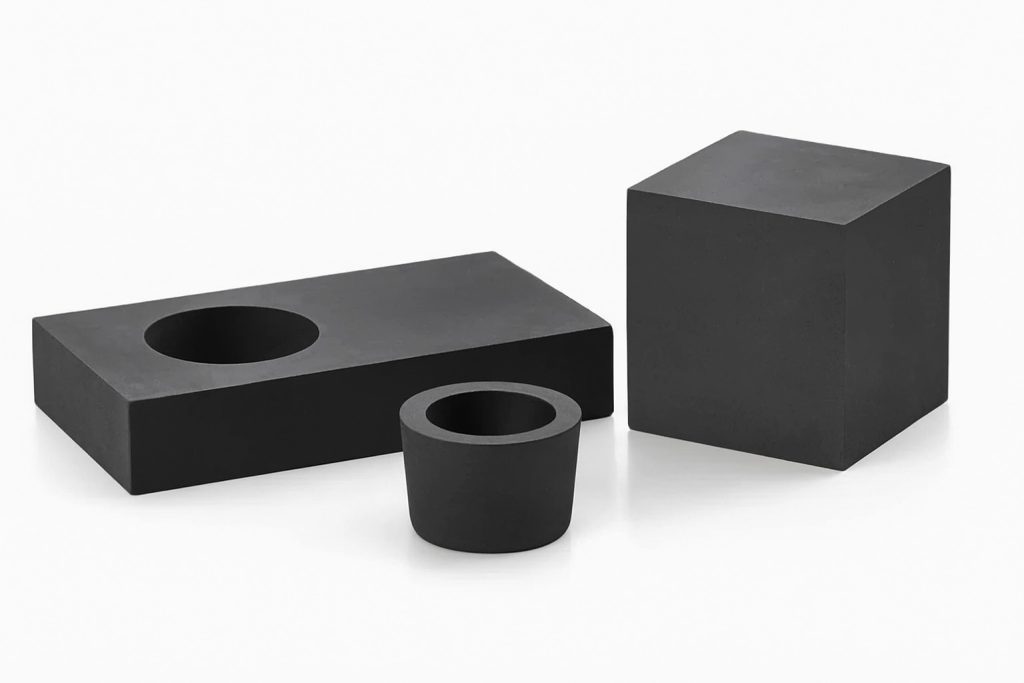
Graphite Mold
A graphite mold is a high-temperature resistant tool made from high-purity graphite. Due to its excellent thermal conductivity, stability, and machinability, it is widely used in high-temperature precision manufacturing processes such as metal casting, glass forming, powder metallurgy, and semiconductor crystal growth, making it an indispensable key consumable in modern industry.
- Custom and standard options available.
- Fast lead times guaranteed.
- High performance at a competitive price.
Graphite Mold Data Sheet
| Purity | ≥99.9% |
| Color | Dark Gray to Black |
| Chemical Formula | C |
| Material Grades | Natural Graphite, Synthetic Graphite, Specialty Graphite, Composites Graphite |
| Density | 1.65–1.95 g/cm³ |
| Maximum Operating Temperature | Up to 3000°C (in inert atmosphere) |
| Thermal Conductivity | 100–200 W/m·K |
Graphite Mold Description
A graphite mold is an industrial tool crafted from high-purity synthetic or natural graphite, valued for its exceptional thermal resistance, high thermal conductivity, low thermal expansion, and strong chemical stability, making it indispensable in precision manufacturing fields such as high-temperature casting, metallurgical continuous casting, powder sintering, glass forming, and semiconductor crystal growth; its smooth surface and self-lubricating properties facilitate demolding and enhance product surface quality, while the machinability of graphite allows for the creation of complex mold structures, balancing structural strength under extreme heat with process flexibility, thus serving as an efficient, cost-effective, and durable key component in modern manufacturing.

Graphite Mold Specifications
| Items | Unit | The Coefficient of Thermal Expansion (CTE) | |
| Grain Size | mm | 0.045-4 | |
| Bulk Density | g/cm3 | 1.65-1.95 | |
| Resistivity | μΩ•m | 8.0-11.0 | |
| Bending Strength | Mpa | 18-55 | |
| Compressive Strength | Mpa | 36-100 | |
| The Coefficient of Thermal Expansion (C.T.E) | ×10-6/ ℃ | 2.9-3.0 | |
| Ash | % | 0.1-0.3 | |
| Products can be customized according to order requirements or specific drawings. | |||
Graphite Mold Features
- High-Temperature Resistance: Can withstand temperatures exceeding 2000°C for extended periods in inert or vacuum atmospheres, with some high-purity grades resistant to extreme temperatures above 3000°C.
- Excellent Thermal Conductivity: High heat transfer efficiency enables rapid and uniform heating and cooling, significantly improving production cycles.
- Good Thermal Stability: Low coefficient of thermal expansion minimizes cracking or deformation under thermal shock, ensuring excellent dimensional stability.
- Chemical Inertness: Resistant to erosion by most molten metals and glass, preventing unwanted reactions and maintaining product purity.
- Self-Lubricating Property: The layered structure of graphite provides natural lubrication, facilitating demolding, reducing wear, and extending mold life.
- Ease of Precision Machining: Relatively low hardness allows it to be easily machined into complex shapes with high surface finish.
- Electrical Conductivity: Inherently conductive, making it suitable for specialized processes such as electrical resistance heating or EDM (Electrical Discharge Machining) applications.
Graphite Mold Applications
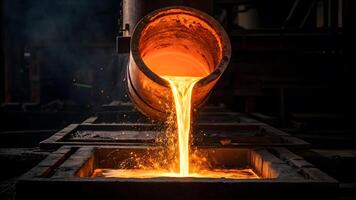
- Continuous Casting & Metal Foundry: Widely used in continuous casting, centrifugal casting, and precision casting of non-ferrous metals and alloys such as copper, aluminum, gold, and silver, to produce castings, bars, or ingots with precise dimensions and smooth surfaces.
- Powder Metallurgy & Sintering: Serves as molds or crucibles for the press-forming and high-temperature sintering of metal powders and ceramic powders to manufacture mechanical parts or electronic components with complex structures.
- Glass Industry: Used for the hot-press molding of glassware, optical glass, glass fibers, etc., leveraging its excellent thermal stability and release properties.
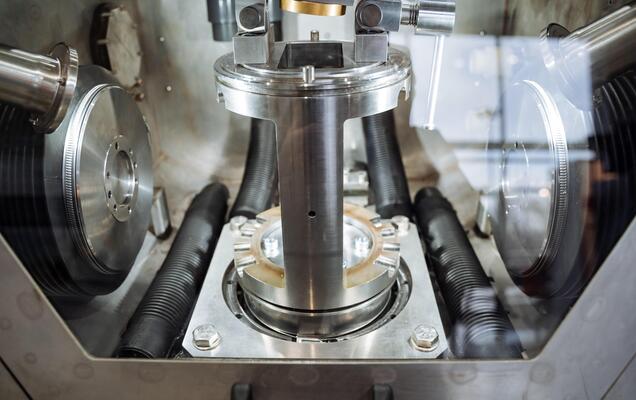
- Electronics & Semiconductor: Acts as a core component in crystal growth (e.g., Czochralski method, Zone melting) of semiconductor materials like monocrystalline silicon and silicon carbide, and also for sintering electronic packaging materials.
- Hard Metal/Cemented Carbide Production: Used in the press-forming and sintering of hard metals/alloys (e.g., tungsten carbide).
- Heat Treatment: Functions as high-temperature resistant fixtures, setters, or furnace liners to hold workpieces during processes like quenching and annealing.
- Electrical Discharge Machining (EDM): Utilizes its electrical conductivity to serve as electrodes (EDM electrodes) for machining mold cavities.
- Other High-Temperature Processes: Such as diamond tool sintering, advanced ceramic sintering, and as susceptors in Chemical Vapor Deposition (CVD) processes.


Graphite Ceramic Packaging
Graphite ceramic products are typically packaged in vacuum-sealed bags to prevent moisture or contamination and wrapped with foam to cushion vibrations and impacts during transport, ensuring the quality of products in their original condition.

Download
- SAFETY DATA SHEET (SDS) -Graphite Mold
FAQ
What is a graphite mold? What are its main advantages?
A graphite mold is a high-temperature resistant tool made from high-purity synthetic graphite. Its key advantages include: exceptional heat resistance (up to 3000°C), excellent thermal conductivity and stability, good chemical inertness, self-lubricating properties for easy release, and ease of machining into complex shapes.
Which industries primarily use graphite molds?
They are widely used in industries requiring high temperatures and precision forming, mainly including: non-ferrous metal casting (e.g., copper, aluminum), powder metallurgy, glass manufacturing, semiconductor crystal growth (monocrystalline silicon), cemented carbide sintering, and as electrodes for Electrical Discharge Machining (EDM).
How durable are graphite molds? What is their service life?
They are highly durable, but service life is not fixed and depends on various factors: graphite grade, operating temperature, cycle frequency, processed metal type, and maintenance. Under standard conditions, a well-maintained mold can last for hundreds to thousands of production cycles.
How to choose the right grade of graphite material for mold making?
Selection depends on application requirements. Key parameters include: compressive strength (high strength for high-pressure sintering), density/porosity (high density for better durability and infiltration resistance), particle size (finer particles for smoother surface finish), and purity & thermal conductivity (extremely high requirements in semiconductor industry).
What is the typical lead time for machining a graphite mold?
The lead time depends on the complexity, size, and precision requirements of the mold. For conventional shapes and medium sizes, it typically takes 1 to 4 weeks from drawings to finished product. Complex or large molds may require longer.
Get A Quote
Request a personalized quote tailored to your specific requirements.