
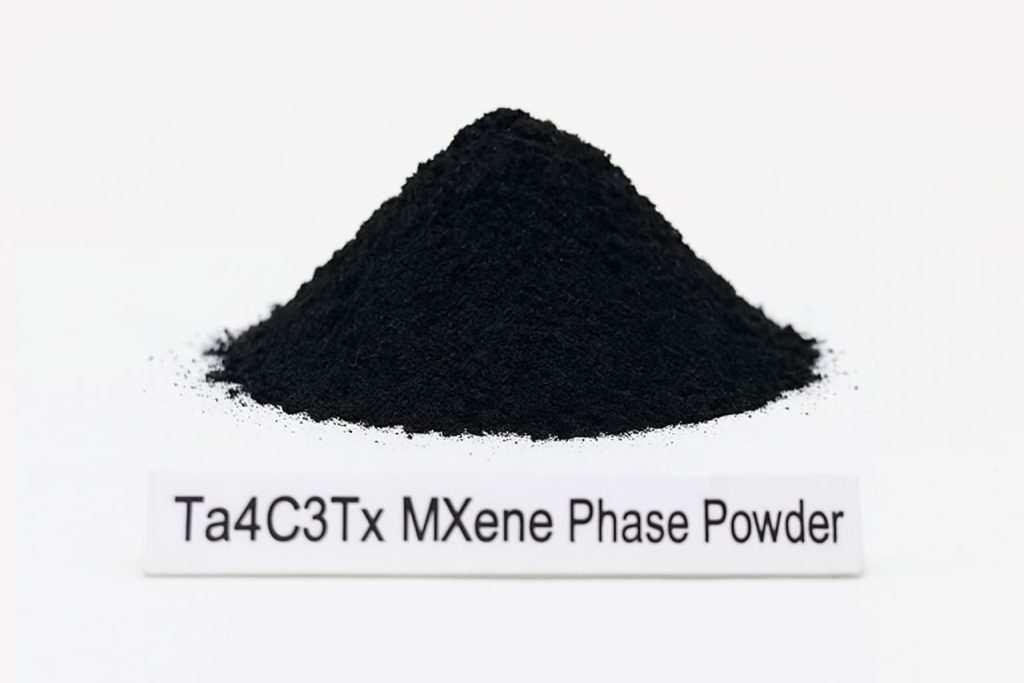
Ta4C3Tx MXene Phase Powder
Ta₄C₃Tₓ MXene Phase Powder is a two-dimensional inorganic compound belonging to the MXene family, derived from the selective etching of the “A” layer from its precursor, typically Ta₄AlC₃. The “Tₓ” denotes surface functional groups (such as -O, -OH, or -F) introduced during the etching process. This material exhibits a distinctive layered structure, high electrical conductivity, excellent mechanical properties, and good chemical stability. It shows significant potential for applications in energy storage (e.g., lithium-ion batteries, supercapacitors), electromagnetic interference shielding, catalysis, and sensors. Its unique combination of metallic conductivity and hydrophilic surface functionality makes it a highly promising nanomaterial for advanced technological fields.
- Custom and standard options available.
- Fast lead times guaranteed.
- High performance at a competitive price.
Ta4C3Tx MXene Phase Powder Data Sheet
| Purity: | ≥98% |
| Size : | 2–20 µm, 200–1000 nm or customized |
Ta4C3Tx MXene Phase Powder Description
Ta₄C₃Tₓ MXene Phase Powder is a highly conductive, two-dimensional transition metal carbide nanomaterial synthesized primarily through the selective etching of aluminum from the Ta₄AlC₃ MAX phase precursor, typically using hydrofluoric acid or fluoride-containing etchants. This process yields accordion-like multilayered particles with exposed surfaces terminated by functional groups (Tₓ), such as -O, -OH, and -F. The powder exhibits a distinctive metallic luster, excellent electrical conductivity, and good hydrophilicity, facilitating dispersion in aqueous solutions. Its layered structure provides a high specific surface area, while its intrinsic properties include notable mechanical strength, chemical stability, and efficient electromagnetic wave absorption. These characteristics make it a promising candidate for advanced applications in energy storage devices like supercapacitors and batteries, electromagnetic interference shielding, catalytic systems, and sensor technologies.
Ta4C3Tx MXene Phase Powder Specifications
| Attribute | Multilayer Ta4C3x Powder | Single-Layer Ta4C3x Powder |
| Etching Process | HF Etching | HF + Intercalating Agent Delamination |
| Size | 2–20 (µm) | 200–1000 (nm) |
| Number of Layers | Multilayer | ≤5 Layers |
| Conductivity (S/cm) | 1–10 | 10–500 |
| Surface Groups | -OH, =O, -F, -Cl | |
| Appearance | Silver-black powdered material | |
| Structure | Two-dimensional layered material | |
| Production Method | Prepared using hydrofluoric acid/intercalation reaction | |
| Performance | Remarkable applications in biomedicine and energy storage | |
| Storage | Stored in vacuum drying or inert environments | |
Ta4C3Tx MXene Phase Powder Features
- Composition & Structure: A two-dimensional (2D) transition metal carbide, with a layered structure derived from etching the Ta₄AlC₃ MAX phase.
- Surface Chemistry: Terminated with functional groups (-O, -OH, -F), denoted as Tₓ, which influence its hydrophilicity and reactivity.
- High Conductivity: Exhibits excellent metallic electrical conductivity.
- Mechanical Robustness: Possesses good mechanical strength and flexibility.
- Hydrophilicity: Has a naturally hydrophilic surface, enabling easy dispersion in water.
- Chemical Stability: Shows good stability under various conditions.
- Functional Applications: Promising for energy storage (batteries, supercapacitors), EMI shielding, catalysis, and sensors.
Ta4C3Tx MXene Phase Powder Applications
- Energy Storage: Widely used as high-performance electrodes or conductive additives in lithium-ion batteries, sodium-ion batteries, and supercapacitors due to its high conductivity and surface area.
- Electromagnetic Interference (EMI) Shielding: An excellent lightweight, efficient material for EMI shielding coatings and composites, absorbing and reflecting electromagnetic waves.
- Catalysis: Serves as an efficient catalyst or catalyst support in electrocatalysis (e.g., hydrogen evolution reaction – HER, oxygen evolution reaction – OER) and photocatalysis.
- Sensors: Applied in highly sensitive chemical and biological sensors (e.g., gas, strain, pressure sensors) because its electrical properties change with surface adsorption.
- Environmental Remediation: Used as an adsorbent for removing heavy metal ions, radioactive waste, and organic pollutants from water.
- Lubrication & Coatings: Enhances wear resistance and provides lubrication in composite coatings and anti-friction films.
- Communications & Optics: Shows potential in terahertz shielding, optical modulators, and other photonic devices.



Ta4C3Tx MXene Phase Powder Packaging
Ta4C3Tx MXene phase powder is typically packaged in sealed, moisture-proof plastic bags, then placed in sturdy drum containers or fiber cartons to prevent contamination and ensure safe transport. Standard packaging sizes include 1 kg, 5 kg, and 10 kg options, with custom packaging available upon request to meet specific usage or storage needs.

Download
- SAFETY DATA SHEET (SDS) -Ta4C3Tx MXene Phase Powder
FAQ
What is Ta₄C₃Tₓ MXene Phase Powder?
Ta₄C₃Tₓ MXene Phase Powder is a two-dimensional transition metal carbide nanomaterial synthesized by selectively etching the aluminum layer from Ta₄AlC₃ MAX phase, with surface functional groups (Tₓ) such as -O and -OH.
What are its key properties?
It exhibits high electrical conductivity, hydrophilicity, layered structure, excellent mechanical strength, and good chemical stability.
What precautions should be taken during use and storage?
Operate in ventilated areas to avoid dust inhalation; store sealed under inert gas (e.g., argon) to prevent oxidation.
How does it differ from other MXenes like Ti₃C₂Tₓ?
Compared to Ti₃C₂Tₓ, Ta₄C₃Tₓ has higher density, better thermal stability, and shows greater potential for electromagnetic shielding applications.
Can it be used in flexible electronics?
Yes, its excellent mechanical flexibility and high conductivity make it suitable for flexible electrodes, wearable sensors, and similar devices.
Get A Quote
Request a personalized quote tailored to your specific requirements.